Ravel team ·
Share Price vs Company Value: Why They Can Tell Different Stories
Price is observed; intrinsic value is estimated. Understand how expectations, cash flows, risk and market trading connect—and why a good company is not automatically a good investment at any price.
- Price: an observed transaction
- Value: an estimate with assumptions
A price tells you what traded—not everything about the business
A share price is visible every trading day. A company’s future is not. That difference is why a chart alone cannot tell you whether a business is becoming stronger or whether investors’ expectations are becoming more optimistic.
Price and value are connected, but they answer different questions. Price records a market transaction. Valuation asks what the future economic benefits may be worth under stated assumptions.
Three terms that should not be mixed
Share price is the trading price of one share. Market capitalization is that price multiplied by shares outstanding: the market’s quoted equity value. Estimated intrinsic equity value is an assessment of the economic value attributable to shareholders. A per-share estimate must account for the relevant share count.
Whole-business value and shareholder value are also different. Debt, cash and other claims can matter when moving between them. Comparing the price of one share with the value of the whole company mixes units and produces a misleading conclusion.
Value is an estimate, not a hidden fact
Discounted cash flow valuation estimates present value from expected future cash flows and an appropriate discount rate. Different assumptions about growth, reinvestment and risk can produce different estimates. [1]
Calling one estimate the “actual value” gives it more certainty than it deserves. A useful valuation makes its assumptions visible and tests how the conclusion changes when those assumptions change. A range of scenarios can be more informative than a precise-looking figure.
Price reflects competing expectations and real trades
It is helpful to think of price as a meeting point for different views. It is not an arithmetic average of everyone’s opinion. Trades occur between participants willing and able to transact, with different information, time horizons and constraints. Someone’s belief does not affect a transaction merely because they hold it.
Damodaran distinguishes valuation driven by business fundamentals from pricing influenced by market demand and supply, sentiment and momentum. These forces interact; price is neither pure psychology nor a perfect reading of fundamental value. [2]
Why the same news can produce a surprising reaction
Consider a hypothetical company that reports lower earnings. If investors expected a much larger decline, the announcement can still improve their expectations. Conversely, a strong result may disappoint when a stronger one was anticipated. These examples illustrate expectations; they do not describe a particular stock.
Markets can process information quickly, while prices remain difficult to predict over short horizons. Research recognized by the 2013 Nobel Prize also examines longer-horizon patterns and the role of fluctuations in asset prices. [3] Shiller’s lecture discusses the contribution of behavioral explanations to understanding speculative markets. [4]
A gap is a question, not an automatic opportunity
When a price differs from your valuation, investigate both sides. Your cash-flow forecast may be wrong. Your risk assumption may be incomplete. Other investors may possess a different interpretation, or trading conditions may be influencing price.
There is no guarantee that price will converge to your estimate within your investment horizon. A falling share price does not establish undervaluation; it may accompany deteriorating prospects. Equally, a well-run company can have a price that requires unusually ambitious future performance. Business quality and investment attractiveness are related but distinct judgments.
Look behind the price with Ravel
The practical next step is to investigate what could change your assumptions about the business. Which event reaches its customers, suppliers or operating inputs? What evidence supports that relationship? How material might it be?
Ravel is being built to make those connections easier to explore, with sources behind the steps. It does not turn an exposure into a guaranteed valuation or price prediction. Read the companion article on world events and company value, then explore our documented examples. Educational content; not personalized investment advice.
See the evidence in the example
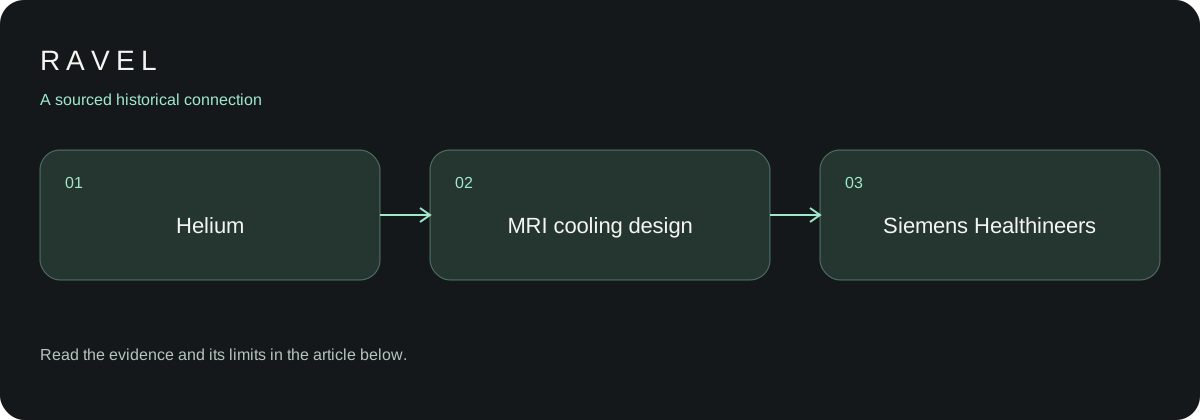
A different kind of gas dependency.
- 01Helium
- 02MRI cooling design
- 03Siemens Healthineers
Historical educational sample. Not investment advice or a performance forecast.
Read the sourcing standards