Ravel team ·
How World Events Affect Company Value—and How Investors Can Trace the Impact
A headline is only the beginning. Learn how to trace events through business dependencies, assess their financial significance, and distinguish early insight from a price prediction.
- Documented event
- Business connection
- Financial scenarios
- Valuation assumptions
The headline is not the whole investment story
A change in export rules may seem far removed from a company that makes imaging equipment. A constraint on water supply may look like a local infrastructure problem until you examine a semiconductor manufacturer’s operating needs. The useful investment question is not simply “What happened?” It is “Through which relationship could this change the business?”
This article explains a research approach, not a formula for predicting returns. An event, a business exposure, a financial consequence and a market response are separate things. Each requires its own evidence.
Follow the mechanism before estimating the outcome
Start with the precise change: an announced rule, an effective restriction, a customer cancellation or an operating disruption. Record what was known and when. Then identify the company’s exposure using filings, contracts where public, technical documentation and dated announcements.
Ask how the exposure reaches revenue, costs, reinvestment or risk. A more expensive input need not reduce earnings if the company can raise prices. A supplier interruption need not stop production if inventory or substitutes cover the gap. Exposure is the starting point for analysis, not the conclusion.
Why business connections deserve attention
Cohen and Frazzini’s 2008 study examined publicly identified customer–supplier links. It found evidence of delayed price adjustment across related firms, consistent with limited investor attention. The important lesson is that information about one business can matter to another even when they are discussed separately. [1]
These are historical findings from a specific study. They are not evidence that every overlooked link remains profitable, that implementation costs are negligible, or that Ravel has demonstrated predictive performance.
Connect operating changes to valuation assumptions
In discounted cash flow analysis, valuation connects expected future cash flows to their present worth through a discount rate. An event becomes financially meaningful when it changes those expectations or the risk attached to them. [2]
Build conditional scenarios rather than a single confident number. What happens if the disruption lasts weeks instead of months? What evidence supports the affected share of the business? Which contract, substitute or management response could weaken the effect? State the assumptions, then identify disclosures that could confirm or contradict them.
Early compared with what?
Detecting an exposure before the next earnings report is different from detecting it before other investors. Both are different from detecting it before the price reflects it. Clear research names the comparison and preserves the dated evidence.
Markets often incorporate new information quickly, and short-term price movements are difficult to forecast. The Nobel Committee’s account of asset-pricing research makes this an essential counterweight to claims about early signals. [3]
A correct business assessment can coexist with an unexpected price move. Investors may already expect the consequence, change the return they demand, or react to another development. Understanding the mechanism improves the question you ask; it does not guarantee a trading advantage.
A real connection to investigate
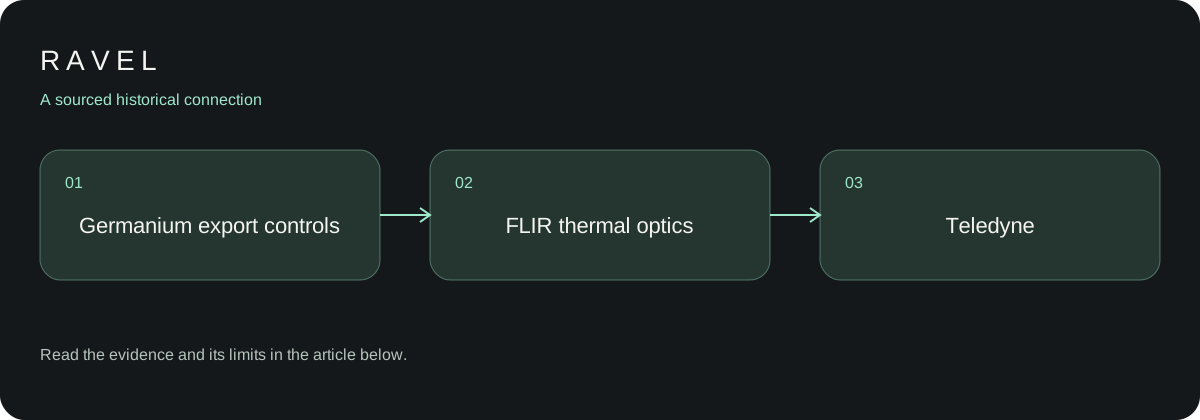
Ravel’s sourced historical example follows China’s 2023 germanium export controls through thermal-imaging applications to FLIR and its parent, Teledyne. Read the linked example below for the documents supporting those steps.
The example establishes a research path. It does not quantify an earnings loss or establish a share-price forecast. It was assembled retrospectively, so it is not proof of advance detection. This distinction is how a compelling story stays an honest one.
See the connection. Check the evidence.
Ravel is being built to help you see how world events reach companies through documented relationships. Its purpose is to make those paths easier to explore and their evidence easier to inspect.
Use the path to improve your research: establish the exposure, test its materiality, update your assumptions, and keep the difference between business value and market price in view. Educational content; not personalized investment advice.
See the evidence in the example
The metal behind the lens.
- 01Export controls
- 02Thermal optics
- 03Teledyne
Historical educational sample. Not investment advice or a performance forecast.
Read the sourcing standards